

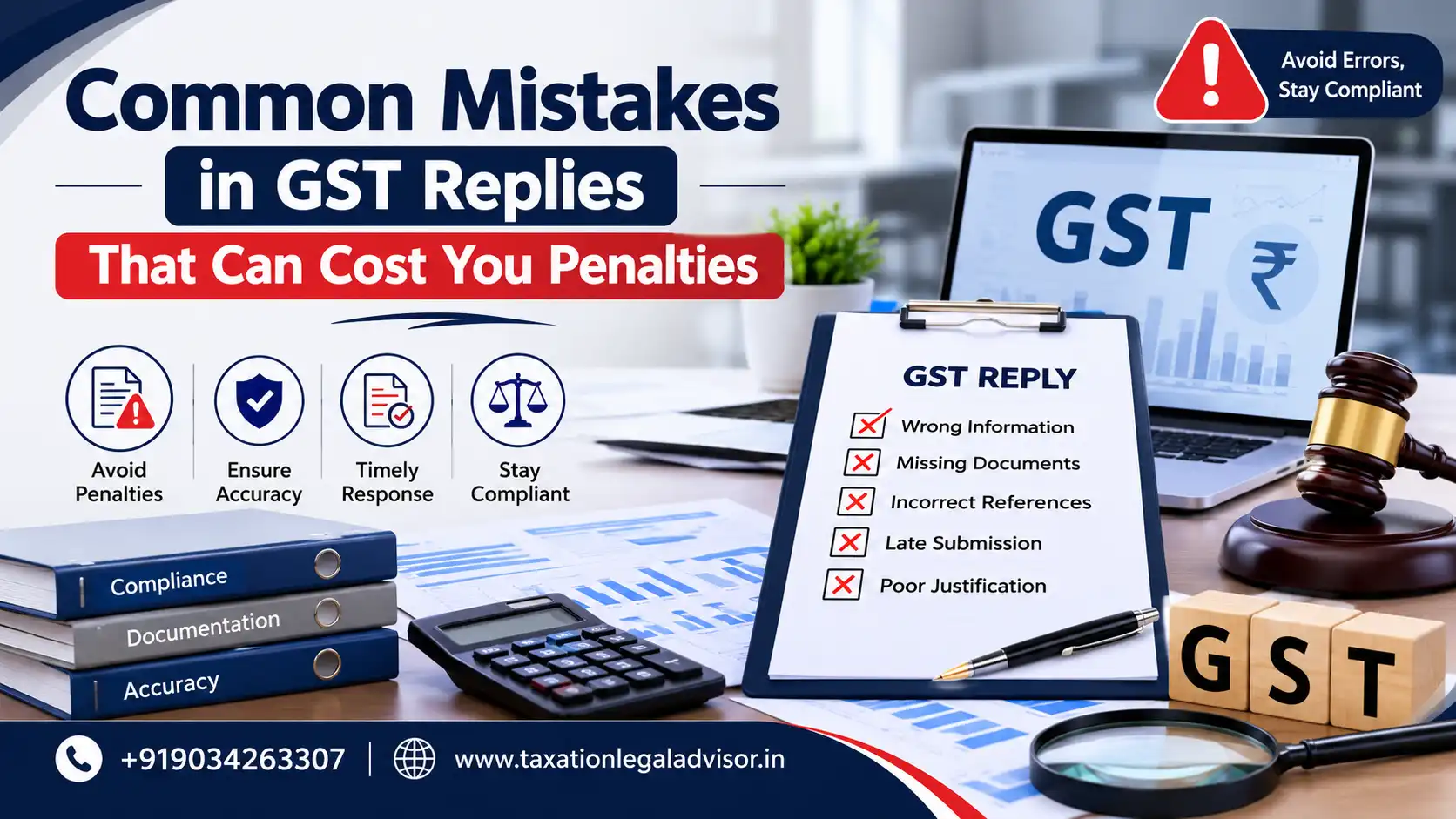
A GST reply is not just a formality. It is often the taxpayer’s first and most important chance to explain the issue, preserve legal objections, and avoid unnecessary penalties.
Many businesses lose strong positions not because the facts are bad, but because the reply is weak, late, incomplete, or mismatched with the notice. GST authorities often look closely at whether the taxpayer responded on time, addressed the exact allegations, and supported the explanation with records.
This article explains the most common mistakes in GST replies and how they can cost penalties. It is shared for knowledge and informational purposes for readers of Taxation Legal Advisor.
Why GST replies matter
Once a GST notice or show cause notice is issued, the reply becomes part of the official record. If the reply is not clear, the officer may proceed on the basis that the allegation is uncontested or insufficiently explained.
That can lead to tax demands, interest, penalty, and in some cases further proceedings. A careful reply can reduce the issue, while a careless reply can make a manageable dispute more serious.
Tax professionals often focus on the notice amount, but the reply stage is where the case is shaped. A poorly written response can weaken even a good factual defence.
Mistake 1: missing the deadline
The most basic mistake is missing the reply deadline. GST systems and manuals make it clear that notices and replies are handled through the portal, and once the reply window closes, the officer may proceed without further hearing.
Late replies weaken the taxpayer’s position significantly. If the reply is not filed in time, the officer may treat the matter as uncontested or issue an adverse order on the available record.
This mistake is costly because it is avoidable. A business that tracks notices properly can usually reply on time, request a hearing if needed, and preserve its defence.
Mistake 2: replying to the wrong issue
Another common error is giving a general explanation instead of answering the exact allegation in the notice. If the notice is about ITC mismatch, but the reply talks only about turnover, the core issue remains unanswered.
GST officers compare the notice grounds with the reply. If the taxpayer does not address the precise tax period, invoice set, or legal provision, the explanation may be treated as incomplete.
A proper reply should be notice-specific. It should follow the same structure as the allegation and answer every material point one by one.
Mistake 3: ignoring the section invoked
The section mentioned in the notice matters. A reply under Section 73 should be different from a reply under Section 74 or another penalty provision, because the allegation level and penalty risk are different.
If the reply does not challenge an incorrect section, the case may proceed on a harsher footing than necessary. Courts and tax authorities have repeatedly treated proper classification of proceedings as important.
This is why tax professionals should always read the section, the wording, and the allegation language before drafting the response.
Mistake 4: giving only a narrative, not evidence
A reply that says “the issue was a mistake” without supporting records may not be enough. The department generally expects books, invoices, reconciliations, purchase summaries, or other documents that explain why the amount was reported in the way it was.
If the reply is only descriptive and not documentary, the officer may give more weight to the department’s data. This is especially important where the dispute involves ITC, returns, e-way bills, or invoice mismatches.
Strong replies combine facts with proof. The records should match the explanation line by line.
Mistake 5: admitting liability too early
Some taxpayers respond too quickly by admitting the tax demand without testing the figures. That can be a costly mistake because once a liability is admitted, the room to challenge the computation becomes narrower.
In many cases, the issue is not fraud but a timing difference, supplier mismatch, classification issue, or missing reconciliation. If the taxpayer admits the demand without checking these points, a possible defence may be lost.
The safer approach is to verify the numbers, compare records, and then accept only what is actually payable.
Mistake 6: ignoring limitation and validity
Many replies focus only on the merits and forget to question whether the notice or proceedings are legally valid. If the demand is time-barred, improperly issued, or procedurally defective, that point can matter as much as the tax calculation.
Recent GST judgments show that courts are paying attention to notice validity, limitation, and fair opportunity. That means a reply should preserve these objections where they exist.
If a taxpayer stays silent on limitation or service defects, the officer may assume the taxpayer has no objection on those grounds.
Mistake 7: using vague language
Replies often fail because they use generic phrases like “matter is under review” or “error is unintentional” without explaining what actually happened. Vague language does not help the officer understand the true facts.
A good reply should be precise. It should say which invoice was missed, which month was affected, how the mismatch arose, and what supporting documents explain the difference.
Precision creates credibility. Vagueness creates doubt.
Mistake 8: not requesting a hearing when needed
If the matter needs explanation, a personal hearing may be necessary. Some taxpayers assume the written reply alone is enough and do not ask for a hearing even when the issue is technical or document-heavy.
That can be risky because a hearing gives the taxpayer a chance to clarify complex points that may not fit neatly into a written reply. It is especially useful where the notice involves multiple periods, reconciliations, or classification issues.
A hearing request should be made thoughtfully, not casually, but it should not be ignored where it can help.
Mistake 9: not matching the reply with books and returns
If the reply says one thing but the books and returns show another, the mismatch becomes a second problem. Officers often compare GSTR-1, GSTR-3B, GSTR-2B, ledgers, and other records.
That means the reply must be consistent with return data and accounts. If there is a timing difference or adjustment, it should be explained openly with a clear reconciliation sheet.
A reply without internal consistency can do more harm than silence.
Mistake 10: treating every notice as routine
Some businesses develop a habit of sending standard template replies for all GST notices. That is dangerous because each notice has its own facts, time period, and legal basis.
A copied reply may miss the exact allegation or overlook the section invoked. If that happens, the officer may treat the response as non-responsive.
Every notice should be tested on its own facts. Templates can help with structure, but they should never replace analysis.
How to reduce penalty risk
A better GST reply starts with four simple steps:
- Read the notice carefully and note the section, period, and allegation.
- Collect supporting documents before drafting the reply.
- Address each issue in the notice point by point.
- Preserve objections on limitation, procedure, and incorrect classification where relevant.
These steps do not guarantee a favorable result, but they significantly improve the quality of the defence.
Final note
Most GST penalties do not arise because taxpayers never had a defence. They arise because the reply was late, vague, unsupported, or addressed the wrong issue.
The reply stage is where facts, law, and records come together. If that stage is handled carefully, the business has a much better chance of reducing the demand, avoiding penalties, or narrowing the dispute.
This article is shared by Taxation Legal Advisor for knowledge and informational purposes only.
Contact Now – +919034263307
Visite websites – taxationlegaladvisor.in


